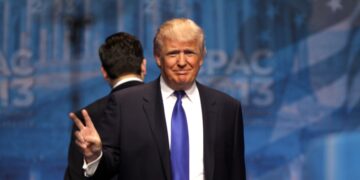

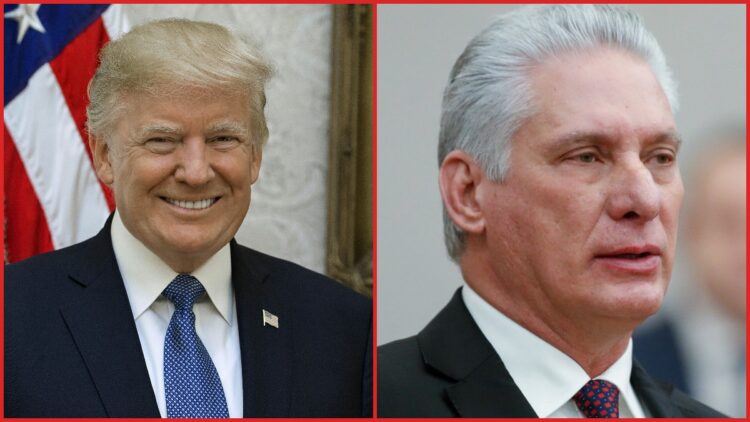
Donald Trump has declared he can do “anything I want” with Cuba, calling the island a “very weakened nation.” Cuban President Miguel Diaz-Canel responded by saying he has no fear and is “willing to give my life for the revolution.”
The escalating standoff comes as the two countries are simultaneously holding diplomatic talks. Trump told reporters in the Oval Office that he expects to have the “honor” of “taking Cuba in some form,” adding: “Whether I free it, take it, I think I can do anything I want with it.”
Diaz-Canel fired back on social platform X, writing that the U.S. “publicly threatens Cuba, almost daily, with overthrowing the constitutional order by force.” He warned that any aggressor “will clash with an impregnable resistance,” according to The Hill.
Cuba’s president refuses to back down
In his first-ever interview with a U.S. broadcast network, Diaz-Canel sat down with NBC News “Meet the Press” host Kristen Welker in Havana. When Welker asked whether he would be “willing to step down to save your country,” the Cuban leader pushed back hard.
“In Cuba, the people who are in leadership positions are not elected by the U.S. government, and they don’t have a mandate from the U.S. government,” he said. “We have a free sovereign state. We have self-determination and independence, and we are not subjected to the designs of the United States.”
He also turned the question back on Welker, asking: “Do you ask that question to Trump?” and whether the question was “coming from the State Department of the U.S.” Welker stood her ground, saying such questions are standard journalism practice.
The oil blockade is crushing Cuba
The Trump administration’s pressure campaign goes well beyond words. After capturing former Venezuelan President Nicolas Maduro in January, the U.S. cut off Venezuela’s oil shipments to Cuba entirely. Trump then threatened tariffs on any country that sells oil to the island.
Also, reports say, Cuba has not received an oil shipment in roughly three months, leading to severe energy rationing and extended blackouts across the island. On one particularly dire day, Cuba’s entire electric grid collapsed, leaving all 11 million residents without power.
Diaz-Canel acknowledged the suffering, telling Welker: “The Cuban people is suffering” from “a number of restrictions which are not applied to any other country in the world.” He said Cuba lacks financing to buy food, medicine, and fuel, and is unable to repair its crumbling energy infrastructure.
The U.S. wants Diaz-Canel out
Behind the scenes, the situation is more pointed. The Newsweek report revealed that the Trump administration has signaled to Cuban negotiators that Diaz-Canel must leave office, though officials are leaving the details of how that happens up to Cuba’s own leadership.
Secretary of State Marco Rubio told reporters that Cuba’s socialist model needs to “change dramatically” and that “you have to change the people in charge.” A White House official said Trump believes a deal “would be very easily made.”
Diaz-Canel flatly rejected the premise. “Resignation is not part of our vocabulary,” he said, insisting that Cuba’s leaders “are not subject to the whims of the United States.” He did add one caveat: “If the Cuban people believe I am unfit for the role, that I haven’t met expectations, then I shouldn’t hold the presidency.”
What comes next for Cuba
Trump has already moved on to Venezuela and Iran. He has also made clear he sees Cuba as the next item on his agenda, saying at a Miami investment forum last month: “Cuba is next.” However, he told reporters his administration would “do Iran before Cuba,” suggesting any direct action isn’t imminent.
Trump’s aggressive posture toward Iran follows a pattern the White House has repeated across multiple conflicts, as seen in how the administration threatened to resume Iran strikes if peace talks failed and the reported U.S. aircraft loss weeks after Trump said Iran’s radar was destroyed.
Analysts at Al Jazeera note that real power in Cuba may not rest with Diaz-Canel at all. Former President Raul Castro and the military-controlled economic conglomerate GAESA, which controls roughly 60 percent of Cuba’s economy, are seen as the true decision-makers. Removing Diaz-Canel, experts say, would not automatically topple the broader system.
Costa Rica added to the pressure this week, with President Rodrigo Chaves announcing his country no longer recognizes Cuba’s government as legitimate and will shut down the Cuban embassy in San Jose.