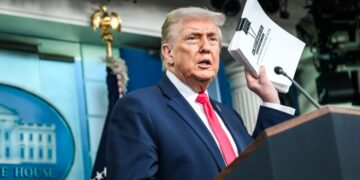

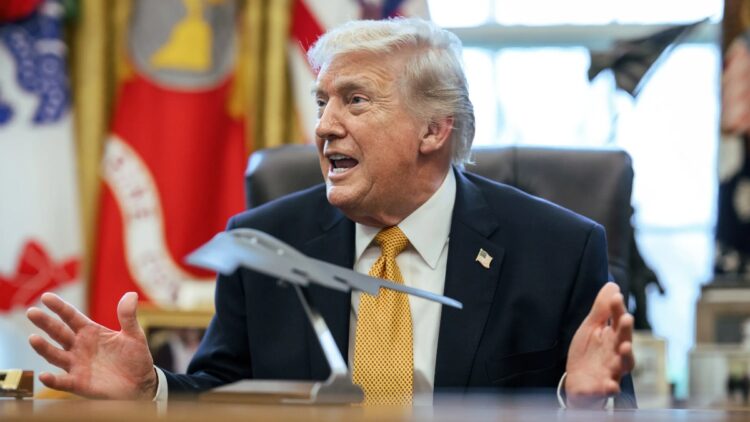
Donald Trump has put his trade deal with Britain on the table as a bargaining chip, warning it “can always be changed” after Keir Starmer refused to back US military strikes on Iran. The threat came during a phone interview Trump gave to Sky News on Tuesday night, and it landed like a grenade in the middle of an already fractured special relationship.
Speaking to Sky News, Trump was asked to describe the current state of US-UK ties. His response was blunt. “It’s a relationship where when we asked them for help, they were not there,” he said. “When we needed them, they were not there. When we didn’t need them, they were not there. And they still aren’t there.” He then turned to the trade deal directly: “We gave them a good trade deal, better than I had to, which can always be changed.”
The agreement struck last year caps US tariffs at 10 percent on most British manufactured goods. In return, the UK opened its markets further to American beef and ethanol. That deal had been hailed by Trump himself as “full and comprehensive” when it was announced, and it gave Britain the lowest tariff rate the US had granted any country at the time.
What sparked the fallout
The tension goes back to last month, when Starmer refused to allow US jets to use Royal Air Force bases for the initial strikes against Iran. He later gave limited permission for two British military bases to be used for what he described as a “specific and limited defensive purpose,” but that partial concession did not satisfy Trump.
Trump also used the interview to go after Starmer’s domestic record, calling his North Sea oil policy “a tragic mistake” and saying Britain was being “invaded” by illegal immigrants. “I love your country and I would love to see it succeed, but if you have bad immigration policies and bad energy policies you have the worst of both,” he said.
The same Politico analysis noted Trump has previously claimed his pressure on Iran was working on the nuclear front, even as the UK government has pushed back hard against his approach to the broader war.
Starmer fires back
Starmer addressed Trump’s comments head-on at Prime Minister’s Questions in the House of Commons on Wednesday. He told MPs his position had not moved. “My position on the Iran war has been clear from the start. We’re not going to get dragged into this war. It is not our war,” he said. “A lot of pressure has been applied to me to take a different course, and that pressure included what happened last night. I’m not going to change my mind. I’m not going to yield.”
The prime minister’s office declined to describe the bilateral relationship the way Trump had, saying the special relationship “exists on multiple levels” and was “far bigger than any individual issue.” UK officials, a spokesman confirmed, were still actively talking to their American counterparts on trade.
It was Liberal Democrat leader Sir Ed Davey who framed Trump’s remarks most sharply in parliament, saying the president had “threatened to rip up his trade deal with the UK as punishment for us not joining his idiotic war in Iran” and comparing his conduct to “a mafia boss running a protection racket.”
King Charles visit still on
One area where Trump appeared to draw a line was the upcoming state visit by King Charles III to the US later this month. Despite everything, Trump said the tensions between him and Starmer would “not at all” affect the royal visit, calling the king “wonderful.”
Starmer backed the trip as well, telling parliament the visit was meant to mark the 250th anniversary of US independence and that the monarchy represented “longstanding bonds and enduring relationship between our two countries, which are far greater than anyone who occupies any particular office at any particular time.”
This isn’t the first time Trump has wielded his relationships with foreign governments as leverage. He has made similar assertions about other countries and their leaders, treating bilateral agreements as personal bargaining chips rather than fixed commitments.
Meanwhile, UK Finance Minister Rachel Reeves was set to meet US Treasury Secretary Scott Bessent on Wednesday on the sidelines of an International Monetary Fund meeting, where the economic fallout from the Iran conflict was expected to dominate discussions.