
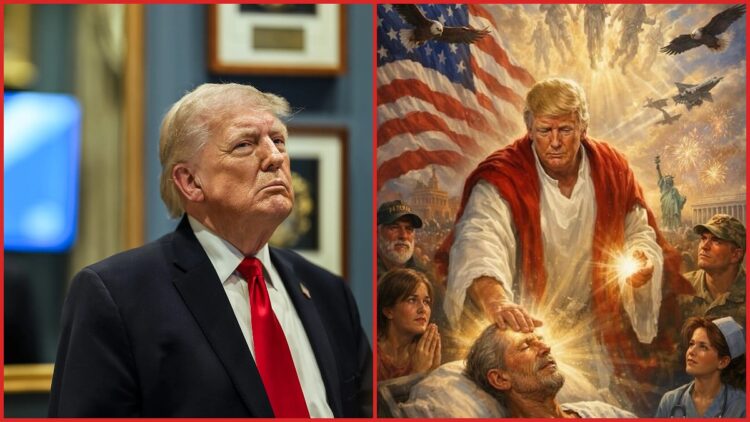
A winged figure with three horns tucked into the background of Donald Trump‘s AI-generated “Jesus” image has sent conspiracy theorists and biblical scholars into a frenzy online. The image, posted on Truth Social, showed Trump dressed in white robes and a red sash, placing his hands on a sick man while golden light radiated from his body. What most people missed at first glance set off a firestorm of end-times predictions.
Per UNILAD, five figures stand in the clouds behind the main scene. Four appear to be soldiers, but the one in the middle drew immediate attention: it is winged, appears to have no head, and has three spiky horns jutting from its form. Fact-checkers at Snopes noted it may simply be an AI hallucination, the kind of nonsensical visual glitch that AI image generators often produce. The White House did not respond when asked what the figure was supposed to represent.
That explanation did little to stop the speculation. Online, users quickly connected the three-horned figure to a prophecy in Daniel 7, a 2nd century BC passage from the Old Testament. “Three horns subdued in Revelation. That’s what WW3 is about, subduing or destroying three kingdoms, it seems,” one X user wrote. Others were more direct: “The reference to the antichrist was intentional,” claimed another user online.
The image and the backlash
The broader scene in the post leaned heavily on Christian and American nationalist imagery. Time magazine noted it was not the first time Trump had courted controversy with AI-generated content, pointing to past posts that depicted him dressed as the Pope and wearing a crown mocking anti-monarchy protesters. This time, however, the blowback came from his own base.
Former Rep. Marjorie Taylor Greene, whose alliance with Trump fractured last year, called it more than blasphemy. “It’s an Antichrist spirit,” she said in a statement circulated widely online. Conservative activist Riley Gaines said “a little humility” would serve Trump better. Ohio Rep. Warren Davidson called the post “very troubling.” Even Trump’s previous AI Jesus post attracted criticism from Christians across the political spectrum before it was taken down on April 13.
Trump’s response
When reporters pressed Trump outside the White House after the deletion, he pushed back on the religious interpretation entirely. “I viewed that as a picture of me being a doctor,” he said. “You know, as a little fun, playing the doctor and making people better. So that’s what it was viewed as. That’s what most people thought.” In a separate interview with CBS News, he said he pulled the post because he “didn’t want to have anybody be confused,” adding: “People were confused.”
Vice President J.D. Vance offered his own spin. “I think the President was posting a joke,” Vance said Monday, per Time. “Of course, he took it down because he recognized a lot of people weren’t understanding his humor in that case.”
The Pope and fresh fuel for the fire
The controversy did not end when the original post came down. On April 15, Trump shared another AI image on Truth Social, this one showing Jesus hugging him, with the caption: “The Radical Left Lunatics might not like this, but I think it is quite nice!!!” The original deleted post also arrived in the middle of Trump’s public dispute with Pope Leo XIV, who had called on his followers to reject “the idolatry of self and money” in response to the Trump administration’s actions in the Middle East. Trump called the American-born pontiff “weak on crime” in response.
As Keir Starmer has pushed back on Trump’s pressure over Iran, the online noise around the Jesus posts underscores just how combustible the intersection of Trump, religion, and AI imagery has become heading further into 2026.