
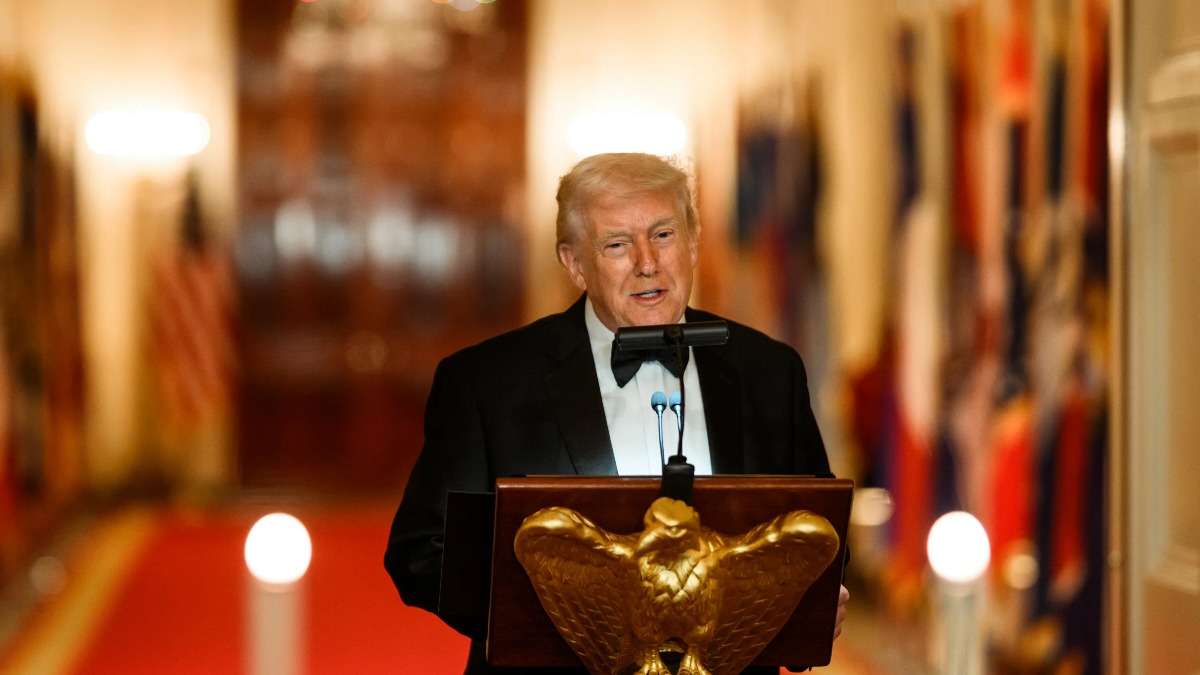
Donald Trump warned Friday night that the United States could resume bombing Iran if no deal is reached before the current ceasefire expires next week. The comment came as tensions over the Strait of Hormuz flared again, with Iranian gunboats firing on a tanker just hours later Saturday morning.
Speaking to reporters aboard Air Force One, according to CBS News, Trump said the U.S. blockade of Iranian ports would stay in place regardless of what happens with the ceasefire. “Maybe I won’t extend it,” Trump said of the two-week pause in strikes. “But the blockade is going to remain. But maybe I won’t extend it, so you have a blockade, and unfortunately, we’ll have to start dropping bombs again.”
The two-week ceasefire, which began April 8, is set to expire on Wednesday, April 22. It was brokered with the help of Pakistani Prime Minister Shehbaz Sharif after Trump had warned that “a whole civilization will die tonight” unless Iran reopened the Strait of Hormuz. Trump ultimately agreed to suspend strikes in exchange for Iran allowing commercial shipping to pass through the vital waterway. The deal has been shaky from the start, with the strait remaining mostly closed during the ceasefire period as both sides disputed the terms.
Iran reverses course on Hormuz hours after declaring it open
Friday brought a brief moment of hope. Iran’s Foreign Minister Seyed Abbas Araghchi announced via social media that the strait was “completely open” to commercial vessels. Trump thanked Iran for the move. But the relief did not last long.
By Saturday morning, Iran had reversed course. Iranian gunboats from the Revolutionary Guard fired on a tanker attempting to transit the waterway, CNBC reported. The United Kingdom’s Maritime Trade Operations center confirmed the tanker and crew were safe but did not identify the vessel or its destination. Ship tracking firm Kpler noted that several tankers and cargo ships had tried to exit the strait on Friday but turned back after being denied passage.
Iran’s joint military command said control of the strait had returned to “its previous state” under the armed forces. Tehran said it was reimposing restrictions in response to the continuing U.S. naval blockade of Iranian ports, which Trump insisted would stay in place until a permanent deal on Iran’s nuclear program is reached.
Trump separately flatly rejected any suggestion of Iran managing tolls or restrictions on the waterway. “Nope. No way. No. Nope,” he told reporters when asked about it.
Talks continue ahead of April 22 deadline
Despite the escalation, mediators expressed cautious optimism that a deal could still be reached before the ceasefire deadline. Trump told reporters negotiations would continue through the weekend. White House press secretary Karoline Leavitt said earlier this week that talks with Iran were “productive and ongoing” and that the administration felt “good about the prospects of a deal.”
Pakistan, which played a central role in brokering the original ceasefire, is expected to host a second round of U.S.-Iran negotiations in Islamabad early next week. Pakistani Field Marshal Asim Munir visited Tehran on Saturday and met with senior Iranian officials, including President Masoud Pezeshkian, to push for a negotiated settlement.
Iran’s deputy foreign minister, however, told reporters in Turkey on Friday that Tehran was not ready for another round of face-to-face talks, saying the Americans had “not abandoned their maximalist position.” Iran also dismissed Trump’s claim that the U.S. would enter the country and “get all the nuclear dust,” referring to the roughly 970 pounds of enriched uranium believed to be buried under bombed nuclear sites.
The fighting in the region has killed at least 3,000 people in Iran, nearly 2,300 in Lebanon, 23 in Israel, and more than a dozen U.S. service members, according to figures from the Associated Press. Trump has already halted direct bombing of Iran once before during this conflict, and critics have warned that the back-and-forth over the ceasefire terms risks collapsing into renewed full-scale war.
The Strait of Hormuz is one of the world’s most critical oil chokepoints, with roughly one-fifth of global oil supply passing through it. The International Energy Agency described the current disruption as more severe than any oil crisis since the 1970s. Oil prices briefly dropped more than 10% on Friday after Iran’s initial reopening announcement, only to erase those gains after news of the reversal spread Saturday. Senator Tim Kaine and other lawmakers have been sharply critical of Trump’s handling of the Iran crisis, calling key decisions among the worst the administration has made.