
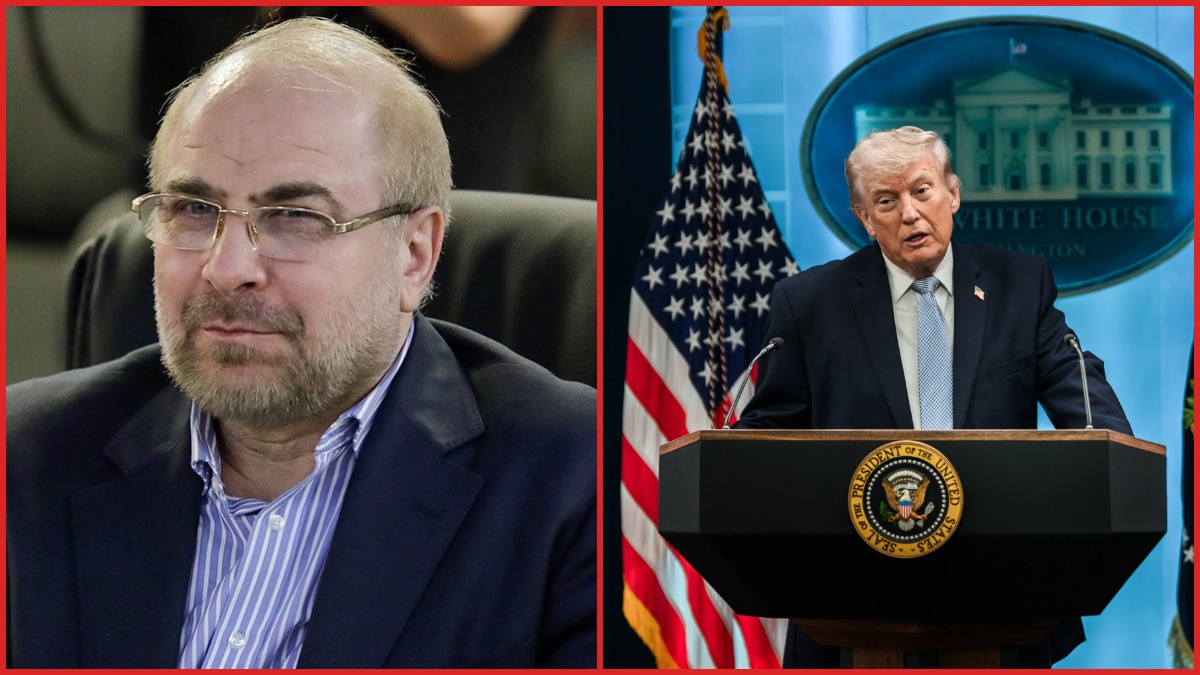
Iran’s parliament speaker has publicly accused Donald Trump of making seven false claims in a single hour, even as the Strait of Hormuz briefly reopened to commercial shipping for the first time since the conflict began.
The accusation came from Iranian parliament speaker Mohammad Bagher Ghalibaf, who posted on social media Friday following Trump’s upbeat public remarks about the state of US-Iran negotiations. According to LADbible, Ghalibaf wrote: “The President of the United States made seven claims in one hour, all seven of which were false. They did not win the war with these lies, and they will certainly not get anywhere in negotiations either.” He then issued a direct warning: “With the continuation of the blockade, the Strait of Hormuz will not remain open.”
Ghalibaf also went further, suggesting Trump was waging an information war against Tehran. “Media warfare and engineering public opinion are an important part of war, and the Iranian nation is not affected by these tricks,” he wrote, according to NBC News.
Iran opened the strait, but the US blockade is still running
The brief reopening of the Strait of Hormuz came on Friday, when Iranian Foreign Minister Seyed Abbas Araghchi declared the waterway “completely open” for commercial vessels for the remaining duration of a 10-day ceasefire. Trump welcomed the news on social media, saying the strait was “fully open and ready for business.” But he also made clear the US naval blockade of Iranian ports would stay in place until, as he put it, “our transaction with Iran is 100% complete.”
That contradiction is at the heart of the dispute. Iran reopened the strait as part of the ceasefire agreement, but the US blockade of Iranian ports remained active. The US military said its blockade “has been fully implemented” and that American forces “have completely halted economic trade going into and out of Iran by sea.” Ship tracking data told a similarly murky story. According to commodity research director Matt Smith at tracking firm Kpler, tankers and cargo ships did attempt to move through the waterway Friday but turned back. “They’ve clearly not been given approval to pass through,” Smith told CNBC.
Iranian media affiliated with the Revolutionary Guard added another layer of conditions, reporting that commercial vessels must coordinate with Iranian forces before passing and that ships linked to hostile nations would not be permitted to transit. As of Saturday, the Islamic Revolutionary Guard Corps said control of the Strait had “returned to its previous state,” meaning it had effectively been closed again due to the ongoing US blockade, which Tehran called “piracy.”
Where talks stand now
Trump has publicly downplayed the gaps between the two sides, telling reporters “a lot of good things are happening” and saying there were no “significant differences” in negotiations. Iran’s statements suggest a very different picture. One of the biggest sticking points is uranium enrichment. Trump claimed the US and Iran had agreed to jointly excavate enriched uranium and move it out of the country, something the Iranian foreign ministry has flatly denied. The US reportedly asked for a 20-year suspension of Iran’s enrichment program during talks in Islamabad. Iran offered three to five years.
Vice President JD Vance, who led that round of talks, said he felt “very good about where we are,” though he acknowledged the two countries were dealing with decades of mistrust and that resolving it “won’t happen overnight.” A second round of in-person negotiations has been floated for this weekend.
Trump had previously halted a planned bombing campaign against Iran while the ceasefire held, though US strikes on other targets have continued in the region. He has also previously warned that Iran’s remaining naval vessels would be “immediately killed” if hostilities resumed.
The Strait of Hormuz is one of the world’s most consequential shipping corridors, with roughly 20 percent of the global oil and gas supply passing through it daily. Disruption there has already rattled energy markets and raised prices globally. A Paris summit of world leaders, including British Prime Minister Keir Starmer and French President Emmanuel Macron, was held Friday to coordinate international pressure on reopening the waterway. The outcome of negotiations remains uncertain.