
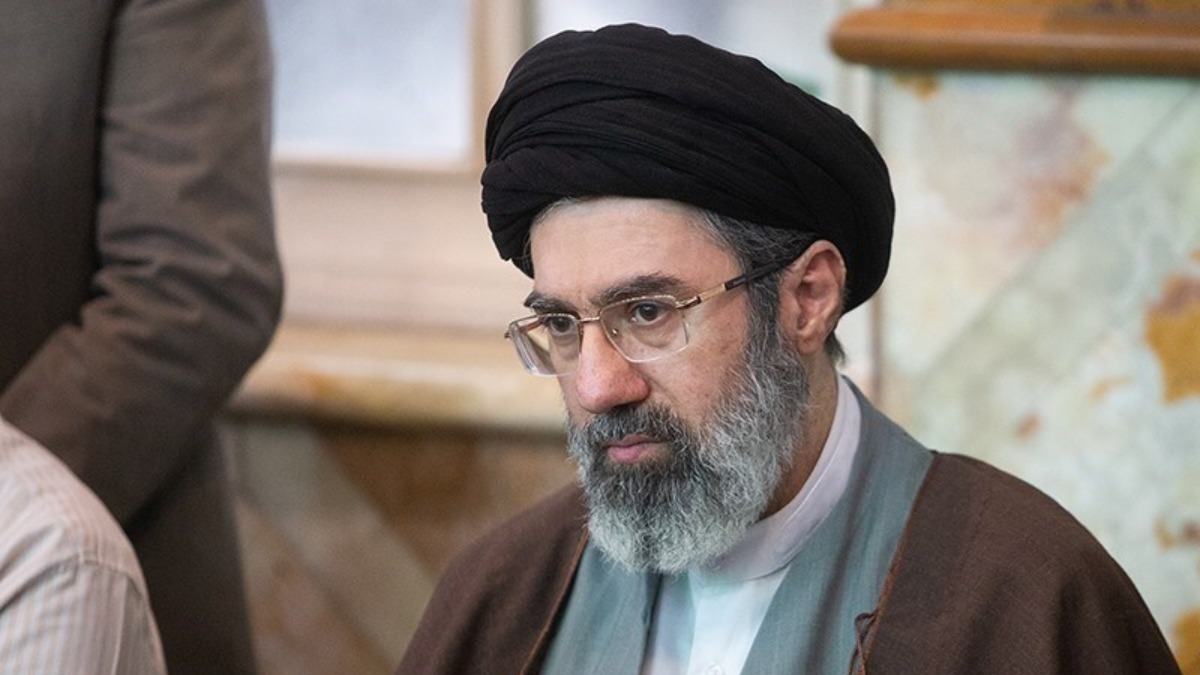
Mojtaba Khamenei hasn’t been seen in public since becoming Iran‘s supreme leader in March. Now a new report reveals why: he’s badly injured, largely cut off from the outside world, and the country’s powerful military commanders are filling the vacuum he’s left behind.
According to The New York Times, Khamenei was wounded in the February 28 airstrike that killed his father, former Supreme Leader Ali Khamenei, along with Mojtaba’s wife and son. Four senior Iranian officials familiar with his condition told the paper that one of his legs has undergone three surgeries and he now awaits a prosthetic. He also had an operation on one hand, which is slowly regaining function, while severe burns to his face and lips have made speaking difficult. Plastic surgery is expected down the line.
Despite those injuries, the officials described him as mentally sharp and engaged. He has avoided recording any video or audio message, not wanting to appear weak in his first public address. Written statements have been issued in his name and read on state television instead. Messages reaching him travel through a human chain of couriers, handwritten and sealed in envelopes, passed by car and motorcycle along back roads to his undisclosed location. They come back the same way.
IRGC generals step into the power gap
Senior IRGC commanders are not visiting Khamenei, out of fear that Israel could track and target his location. That isolation, combined with his injuries and lack of political standing compared to his father, has handed real authority to the generals around him.
Ynet News reported that the key figures now holding sway include IRGC commander Ahmad Vahidi, Gen. Mohammad Bagher Zolghadr (recently appointed head of the Supreme National Security Council), and Gen. Yahya Rahim Safavi, who served as top military adviser to both the elder and younger Khamenei. These generals drove the strategy behind Iran’s attacks on Israel, the closure of the Strait of Hormuz, and the terms of a temporary ceasefire with the United States.
Abdolreza Davari, a former adviser to ex-Iranian President Mahmoud Ahmadinejad, described the arrangement to the Times this way: Mojtaba “is managing the country as though he is the director of the board,” while “the generals are the board members.” Ali Vaez, Iran director at the International Crisis Group, was more blunt: “Mojtaba is not supreme; he might be leader in name, but he is not supreme the way his father was.”
Foreign minister sidelined, ceasefire talks reshuffled
The power shift has already reshuffled Iran’s diplomatic lineup. Foreign Minister Abbas Araghchi, who led negotiations with Washington before the war, has been pushed aside. Parliament speaker Mohammad Bagher Ghalibaf now heads Iran’s talks with the US, and the delegation negotiating with Vice President JD Vance in Pakistan included Revolutionary Guard generals for the first time. The generals halted one round of talks amid tensions over the Strait of Hormuz blockade, overruling political figures who wanted to continue.
Iranian President Masoud Pezeshkian, a trained cardiac surgeon, is personally involved in Khamenei’s medical care alongside the country’s health minister, according to Mediaite. The report’s picture of Iran’s leadership is one where the supreme leader title still belongs to Khamenei on paper, but the real levers of wartime power sit with a small group of hardened generals who have known him since his teenage years on the Iran-Iraq battlefield.
The situation has drawn attention in Washington too. Shortly after the Times report published, US President Donald Trump posted on Truth Social: “Iran is having a very hard time figuring out who their leader is!” He added that the US has “total control over the Strait of Hormuz” and that no ship can pass without US Navy approval.
Iran’s defiance of Trump’s earlier threats signals the IRGC-led government is not backing down easily, even as the Trump administration navigates its own legal battles at home.