

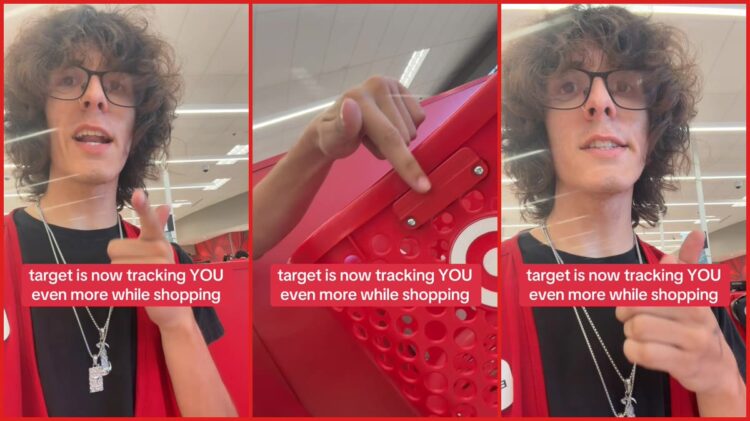
A TikTok video posted by a Target employee alleges that an employee alleges the retailer’s red shopping baskets contain tracking technology. The employee, who appears to be filming from inside a store, directly addresses the camera to make the claim.
In the video, the individual, who is wearing a red Target vest, states, “Hello, I just wanted to make a PSA. You are now being tracked at Target.” They gesture toward a red shopping basket and point to a specific component, asserting, “These baskets, this thing, that’s a tracker.”
The employee further claims that this technology is being implemented to monitor customer activity. “So they’re now tracking shoppers at Target, at your local Target, um, for supposedly consumer habits,” they said in the video. On-screen text in a red box reads, “target is now tracking YOU even more while shopping.”
Employee’s claim sparks discussion on social media
The video, shared with a caption that includes the hashtags “#files #government #flock,” has drawn attention online. The visual content shows the employee holding up the basket and pointing to its underside to highlight the alleged device before concluding the video with a peace sign.
Target has not publicly commented on the specific allegation made in the video. The claim has prompted a range of reactions in the comment section of the post. One user wrote, “Jokes on them, I awkwardly carry everything in my arms to the register because I never think I need a cart or basket.”
Another comment noted, “Giving this message while in uniform is wild.” A third user offered a pun, stating, “I guess you can say we’re being, TARGETED? Eh?”
Some comments connected the video to other recent issues. “I haven’t shopped at Target since they got rid of DEI,” one person remarked. Another speculated about potential employment consequences, writing, “If they fire you for this, the go fund me will be worth it.”
The video’s caption and the employee’s statements have fueled a broader conversation about retail surveillance and consumer privacy. While the employee presented the information as a public service announcement, the accuracy of the technical claim regarding the baskets remains unverified.
The TikTok user who posted the video has an account name that appears as a series of blank spaces. The video has been viewed and shared multiple times, with the comment section continuing to grow as more users engage with the post.
Target’s use of data collection for understanding shopping patterns is a known practice in the retail industry, but the specific method alleged in this video—embedding trackers directly into handheld shopping baskets—is a new and unconfirmed claim. The company’s privacy policy outlines various data collection methods, but does not explicitly mention tracking devices in store equipment.
The video concludes without providing further evidence or documentation to support the allegation. The employee’s claim stands as a personal statement made in a video that has since circulated on social media platforms.
Public reaction highlights concerns over in-store monitoring
Comments on the video reflect a mix of skepticism, humor, and concern about privacy. “Who is still shopping Target,” one user questioned, referencing other recent controversies surrounding the retailer.
The discussion has extended beyond the initial video, with users sharing their own experiences and opinions about retail tracking. The use of the word “tracker” in the employee’s statement has particularly caught the attention of viewers, some of whom expressed surprise at the allegation.
The video’s format—a direct-to-camera message from an employee in uniform—has been a point of discussion itself. Several commenters noted the unusual nature of such a public statement being made while on the job.
As the video continues to circulate, it adds to ongoing public discourse about how companies gather data from customers in physical retail spaces. The specific claim about shopping baskets, however, remains an allegation made in a social media post without official confirmation from Target.